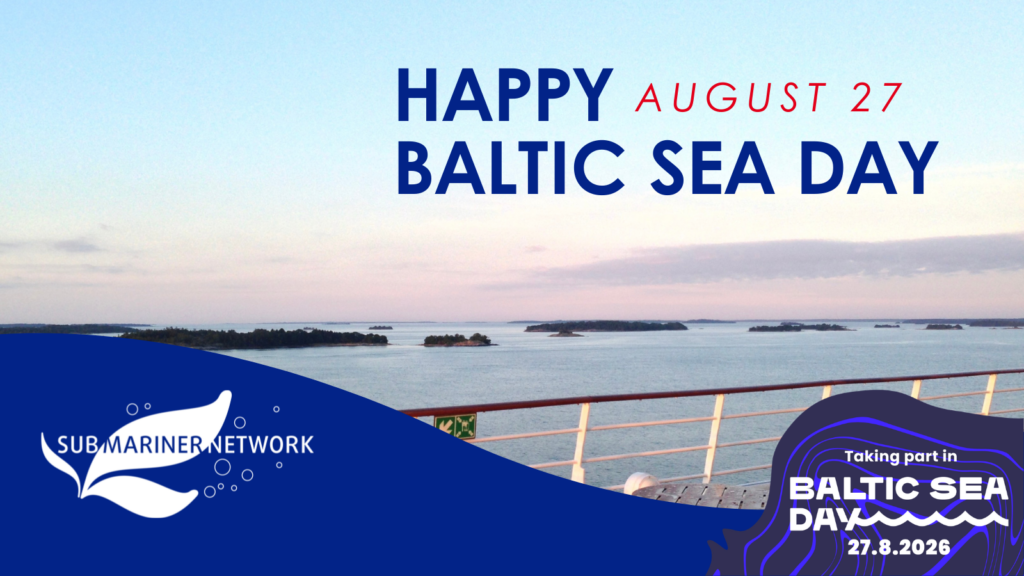
The Baltic is unusual among the world’s seas. It exchanges water with the open ocean only slowly, through the narrow Danish straits, so the same water can remain in place for up to 30 years. That single fact explains a lot: nutrient run-off, warming, and habitat loss show up here, and linger longer, than in most other seas. It is also, for related reasons, one of the most closely researched seas in the world. Decades of cooperation between researchers, public authorities, businesses, and civil society have built one of the most detailed pictures we have of any regional sea, and of what it will take to turn things around. Baltic Sea Day, coordinated by the John Nurminen Foundation, exists to bring that picture to a wider audience each year.
Why the Baltic Sea ecosystem is so sensitive
Three features drive most of what makes the Baltic Sea ecologically fragile:
- Shallow depth. The Baltic averages around 54 metres deep, far shallower than most seas, which limits how quickly it can dilute pollution.
- Low salinity. As a brackish sea, it supports fewer species than a fully marine or fully freshwater system, so the loss of any one species has an outsized effect.
- Slow water exchange. Water entering the Baltic can take decades to fully cycle out again, meaning pollutants and nutrient loads accumulate rather than disperse.
These same features are why the region has become a proving ground for transnational marine cooperation, and why organisations like SUBMARINER Network exist.
SUBMARINER’s work in the Baltic Sea Region
SUBMARINER Network connects research institutes, companies, public agencies, and NGOs working on sustainable marine resource use across the Baltic Sea Region, helping local solutions scale into region-wide impact. Most of our projects have a direct connection to the Baltic Sea, and two we coordinate sit at the centre of that work:
- Blue Mission BANOS coordinates the EU Mission “Restore our Ocean and Waters” across the Baltic and North Sea. It connects national, regional, and transnational actors from policy, industry, and science to accelerate the shift to a carbon-neutral, circular blue economy, and to prevent pollution and restore marine and freshwater ecosystems.
- BlueActionBANOS, running until 2029, puts that same mission directly in the hands of local communities, providing cascade funding, expert guidance, and hands-on support to community-led groups restoring their own local waters.
The Baltic’s problems, eutrophication, biodiversity loss, and fragmented governance across nine coastal states, do not stop at national borders, so the solutions cannot either.
Where to learn more about the Baltic Sea ecosystem
A good starting point is our Blue economy resources hub, a collection of free online courses and learning materials on the blue economy, from algae cultivation to blue biotechnology entrepreneurship. For research and project outputs, our Publications page and our State of Play covers where our work at region stands today.
To connect directly with others working on these issues, BlueActionMatch is our community platform for research, business, and policy contacts across the blue economy.